2026 · 06 · 15 · interview · maison mujō
Azu Kimura — “Thread of Being”, the spider & the sound
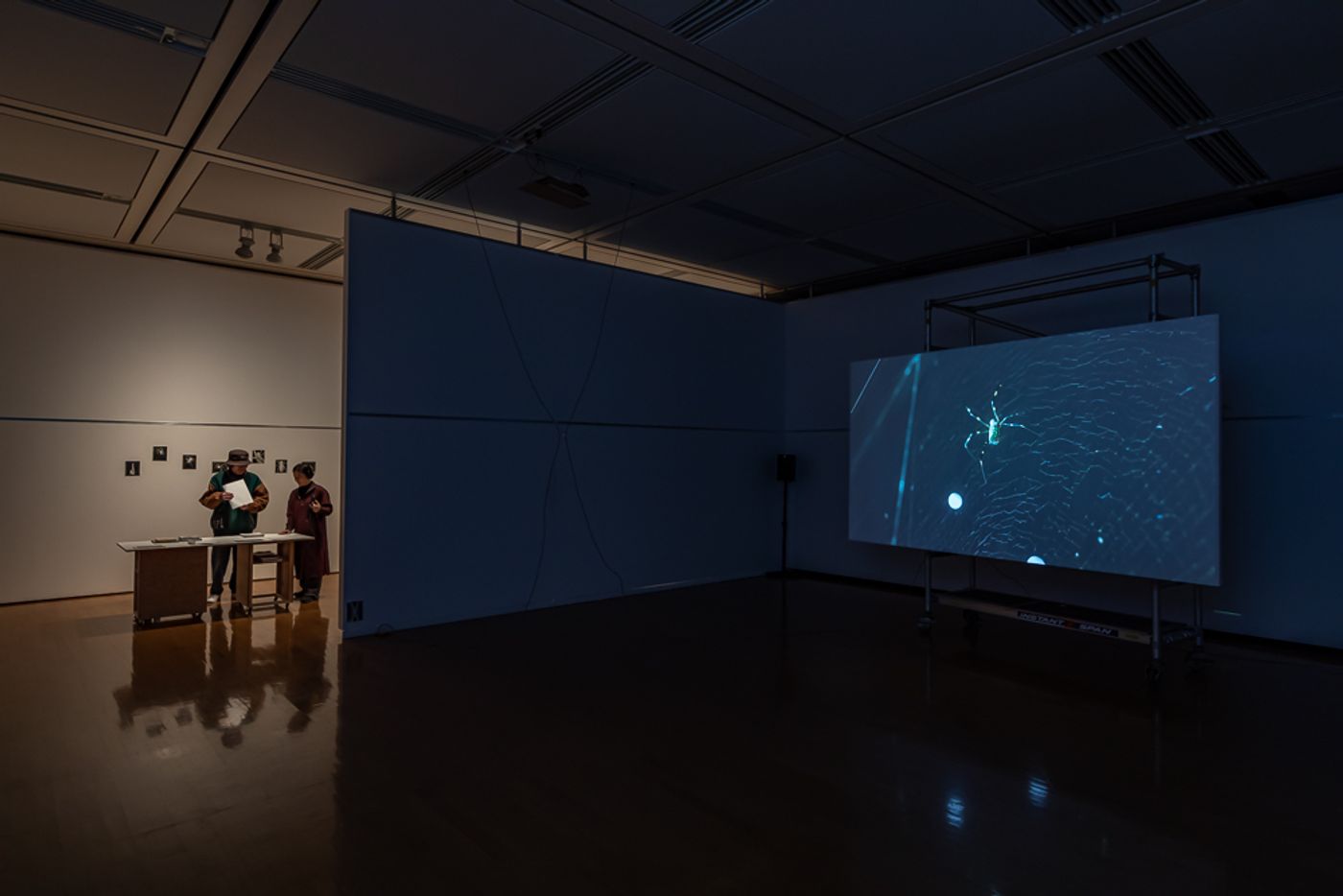
Azu kimura is a visual artist living between tokyo and kofu, japan. A graduate of musashino art university’s faculty of art and design, she worked as a designer at a garden and flower company — an experience that drew her ever deeper into plants and living organisms, and finally into a practice built around the theme of life. Across drawing, sculpture, installation and moving image, she traces the intricate ties between living beings and the worlds they inhabit.
For thread of being — her film centred on the jorō spider, shown at fuchu art museum’s citizens’ gallery in 2024 — kimura asked jonathan fitas to compose the sound. His project infrasonge sits at the contemplative edge of asmr, treating sound less as accompaniment than as a physical, inhabitable space. We spoke with her about umwelt, the perceptual worlds of other creatures, and what happens when a spider’s web is given a body in sound.
We can never truly know how another creature experiences reality.
Q: Azu, can you introduce yourself and tell us about your artistic journey?
After graduating from an art university in tokyo, I worked in landscape horticulture. Through that experience, my interests gradually expanded beyond plants to include insects, geological formations and other elements closely connected to them. Today, my work mainly explores the theme of life.
For example, I have raised insect larvae and made drawings using pigments found in their droppings, and I have made works using iron-oxide films collected in the field, associated with iron-oxidising bacteria. Fieldwork plays an important role in my practice, and I develop my work through encounters with non-human organisms and natural phenomena.
I’ve also spent many years observing jorō spiders. For a long time, I wanted to make a moving-image work that explored their behaviour and the way they experience the world.
Q: Your work explores the relationships between humans and the natural world, particularly through the concept of umwelt. Can you explain this approach?
In japan, there’s a tendency to give names to animals and other living things, and to relate to them in quite anthropomorphic ways. I grew up loving animals and insects, and spent much of my childhood observing, drawing and caring for them.
Later, I encountered the writings of jakob von uexküll and learned that every living being inhabits its own unique umwelt, or perceptual world. I was deeply struck by the realisation that we can never truly know how another creature experiences reality.
At the same time, a spider’s web cannot exist independently of its environment. Its form changes according to the landscape and the space around it. In that sense, it emerges through a relationship with the world rather than existing on its own.
The spider and I breathe the same air and share the same environment. We’re not isolated from one another but connected through networks, much like the threads of a web. That feeling of interconnectedness lies at the heart of this work.
Q: Since 2021 you’ve observed jorō spiders daily. What fascinated you about them to the point of making them the central subject of thread of being?
Jorō spiders are very familiar creatures in japan. They can be found almost everywhere, from cities to rural landscapes, which makes long-term observation possible.
They’re also relatively large, with long legs, and there’s a particular beauty in the way they move — slow and graceful. I felt they would translate especially well into film. For those reasons, I chose the jorō spider as the central figure in the project.
Q: How did you discover jonathan fitas’s work, and what made you want to collaborate with him?
At the time, I was sharing a studio with another artist who had been a fan of jonathan’s music for years. I’d been struggling to find the right sound for the film, so I showed her some footage and asked for her thoughts.
She immediately recommended jonathan’s work, particularly infrasonge #5 ‒ rainfall. As soon as I heard it, I felt a strong connection. It seemed to fit the atmosphere of the film perfectly, so I contacted him directly and asked if he’d be interested in collaborating.
Q: What particularly touched you in his music? What were you expecting from this sonic collaboration?
What I love most about jonathan’s music is the way it evokes images and places. Whenever I listen to it, vivid landscapes seem to appear in my mind.
At the same time, his work feels less like a conventional composition and more like sound as a physical presence. It doesn’t simply accompany an image; it creates a space around it.
Infrasonge #5 ‒ rainfall is centred on water, and there are scenes in the film where the spider is covered in droplets. I felt the texture and atmosphere of the music resonated beautifully with those images.
Q: In the exhibition concept you write: “something that does not exist in the spider’s world becomes present when it is caught in the web.” how did jonathan’s music help translate this idea?
Jorō spiders are thought to rely more on vibration than vision. If I bring my hand close to a web, the spider often doesn’t react, but it responds immediately to subtle vibrations travelling through the silk. In that sense, the web functions as an extension of its sensory system.
In the film, a white sphere touches the web and triggers a response from the spider. This represents the moment when something new enters the spider’s umwelt.
I also see this as a metaphor for human perception. There may be countless relationships, connections and networks around us that we simply don’t notice.
Jonathan’s music has a remarkable ability to evoke things that exist just beyond conscious awareness, as well as the subtle presences hidden within silence. Even the title infrasonge feels deeply connected to the themes of the work.
Q: You also created the installation spider thread telephone, using a 440 hz tuning fork and jorō spider silk. What role does sound play in exploring these creatures’ cognitive abilities?
Jorō spiders are said to recognise vibrations between roughly 300 and 700 hz as signals associated with prey, and they’re thought to respond to the vibration of a 440 hz tuning fork.
In spider thread telephone, visitors listen through a paper cup to the vibration of a tuning fork transmitted along spider silk. The work is an attempt to offer a small glimpse into a sensory world humans can’t directly experience.
A central theme throughout my practice is the act of trying to understand what remains beyond our understanding. This installation is one way of approaching that question.
Q: What do you take away from this collaboration with jonathan? Do you have other projects combining visual art and music?
For the exhibition at fuchu art museum, I installed multiple speakers throughout the space to create an immersive environment. When I finally experienced the film and jonathan’s music together in the gallery, I was genuinely surprised by how tangible the spider’s presence became — it felt as though the spider was actually there with us.
In the future, I’d like to keep researching the vibrations produced by spiders themselves. I’d love to explore making music using spider silk and spider-generated vibrations as part of the composition process.
Recent exhibitions include thread of being (fuchu art museum citizens’ gallery, 2024), life of insects (university of tokyo komaba museum, 2023, within fundamentalz fes) and landscape of iron (nidi gallery, 2022).