When Thoughts Turn to Dreams — Jonathan Fitas
2026 · 08 · 07 · release · maison mujō
There is a narrow country between being awake and being asleep, and it is there that Jonathan Fitas has gone looking for this music. When Thoughts Turn to Dreams opens the door on that threshold — the moment the day loosens its grip and the mind begins to drift.
The piano leads from the first bar and carries the whole track — patient arpeggios, unhurried, the way breath settles when sleep is near. It is only toward the end that the violin enters, and barely as a violin: played in harmonics, it thins to something closer to a flute, a high and weightless voice calling from another room, or from further off than that. Those closing harmonics may remind some of the harmonics in Bartók’s Romanian Folk Dances, or sound a distant echo of “L’Étranger” from Mica Levi’s Into the Void score. Nothing insists; the two instruments leave a great deal of air between the notes, and it is in that air that the piece does its quiet work.
This is the first single from A Quiet Place, the EP Jonathan Fitas will release on 9 October 2026 — his first entirely acoustic record, and a return to the violin, the instrument he played long before he began to compose. The whole project carries that homecoming in its grain, its harmonies veiled with the hush of Debussy’s Préludes.
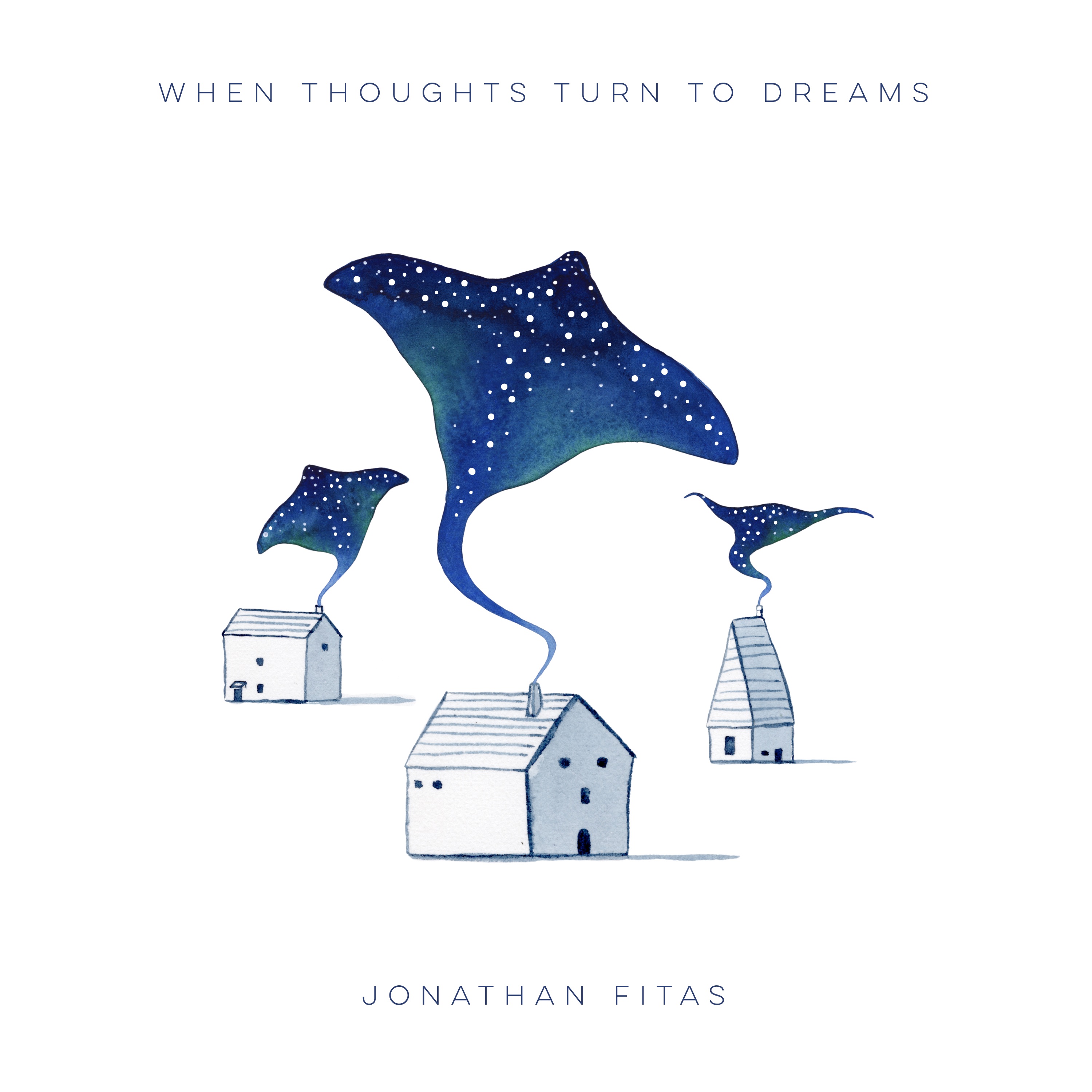
The cover, painted by hand by artist Sophia Vesna, holds the same image the music does: three night-blue rays, scattered with stars, rising like smoke from the chimneys of small sleeping houses. Thought becoming dream, leaving the roof, drifting up into the dark.
Listen once before sleep, and let it carry you across.
Listen to When Thoughts Turn to Dreams →
Elegy (for Violin & Piano) — Jonathan Fitas
2026 · 08 · 28 · release · maison mujō
With Elegy, everything comes down to two instruments: a violin and a piano, nothing placed between them. The violin sings openly, lyrical and unguarded, carrying the fragile virtuosity of Jonathan Fitas’s classical training — every shift of the hand, every change of bow left audible. Two voices in a room, with air enough around them to breathe.
Jonathan Fitas was a violinist long before he was a composer, and Elegy sounds like a man returning to his first language after years away — speaking it slowly, carefully, meaning every word. The piano keeps its counsel, offering a few grave chords, a little ground to stand on; the violin sings above it with a restraint that makes the lyrical moments land all the harder when they come. It is minimal, but it is not cold. Grief, here, is tender.
This is the second single from A Quiet Place, out 9 October 2026 — Jonathan Fitas’s first fully acoustic project, built entirely around the return to the violin. Here it is pared back until only the dialogue of the two instruments remains.
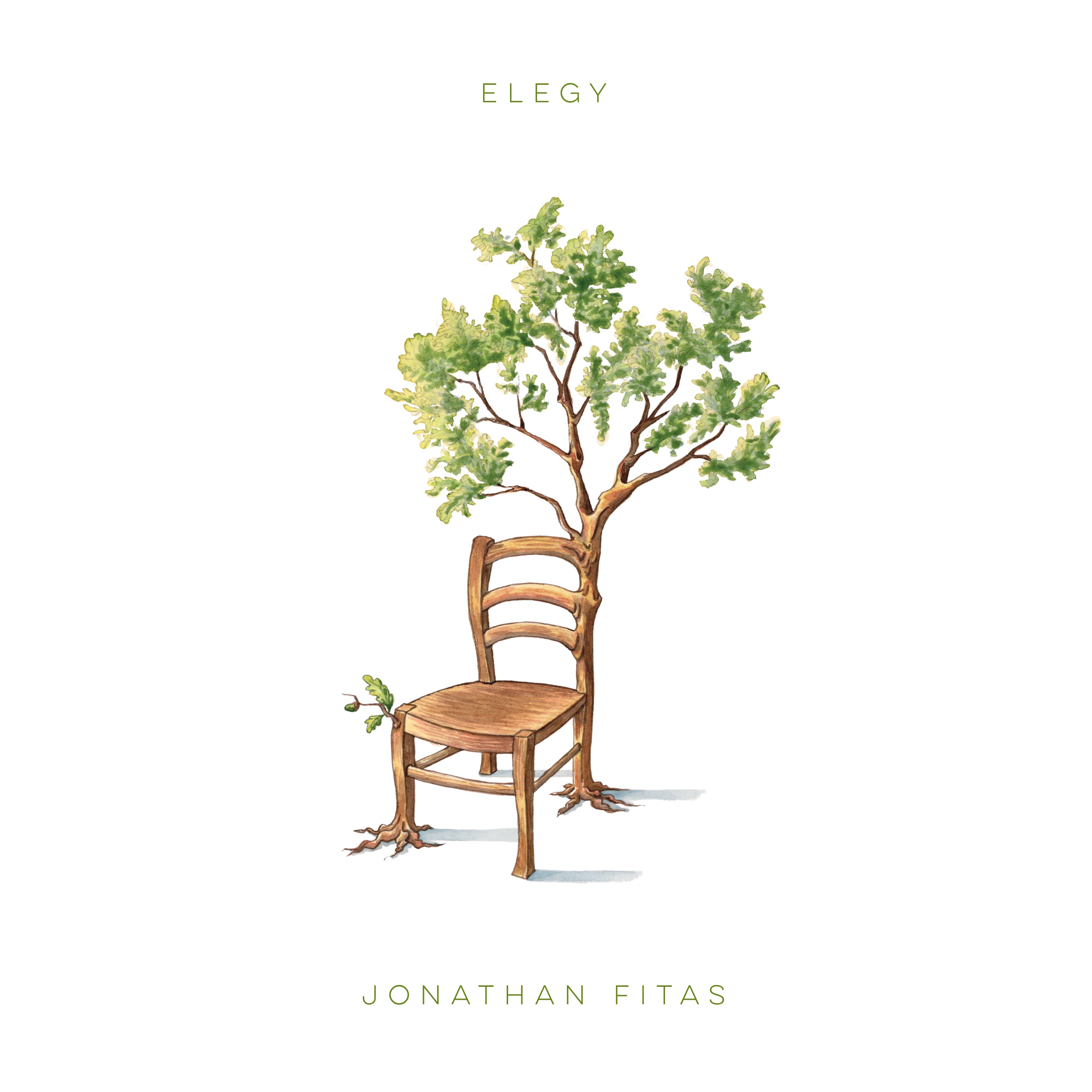
Sophia Vesna’s hand-painted cover holds the whole feeling: a lone wooden chair — solitude, old age, the wear of time — from which an oak springs back to life, its legs sending roots into the ground and its back breaking into leaf. What was cut and shaped returns, living, to the tree it came from.
Sit with it. It asks for nothing but your attention, and returns it in full.
Listen to Elegy →
Pasithea’s Garden — Jonathan Fitas
2026 · 09 · 18 · release · maison mujō
For two singles the music has held almost perfectly still. With Pasithea’s Garden, at last, it begins to move — a gentle, strange waltz whose three beats fall just where you expect them, a perpetual swaying that turns through the garden of sleep like a dancer already half-dreaming.
The harmony is where the strangeness lives. Jonathan Fitas writes in a mode here, letting the melody slip between the veiled colours of Debussy’s impressionism and something far older — the scales of ancient Greece, with their particular light and shadow. The violin leads and the piano answers in three-time; the whole thing sways rather than marches, sweet one moment and faintly uncanny the next, the way a garden feels at dusk.
The title reaches back into myth. Pasithea was the Greek goddess of rest and relaxation, given in marriage to Hypnos, god of sleep — so this is quite literally the garden one wanders once the mind lets go. It makes a fitting close: the third and final single before A Quiet Place arrives on 9 October 2026, Jonathan Fitas’s first entirely acoustic record and his return to the violin, its harmonies threaded throughout with Debussy’s Préludes and the folk pulse of Bartók’s Romanian Folk Dances.
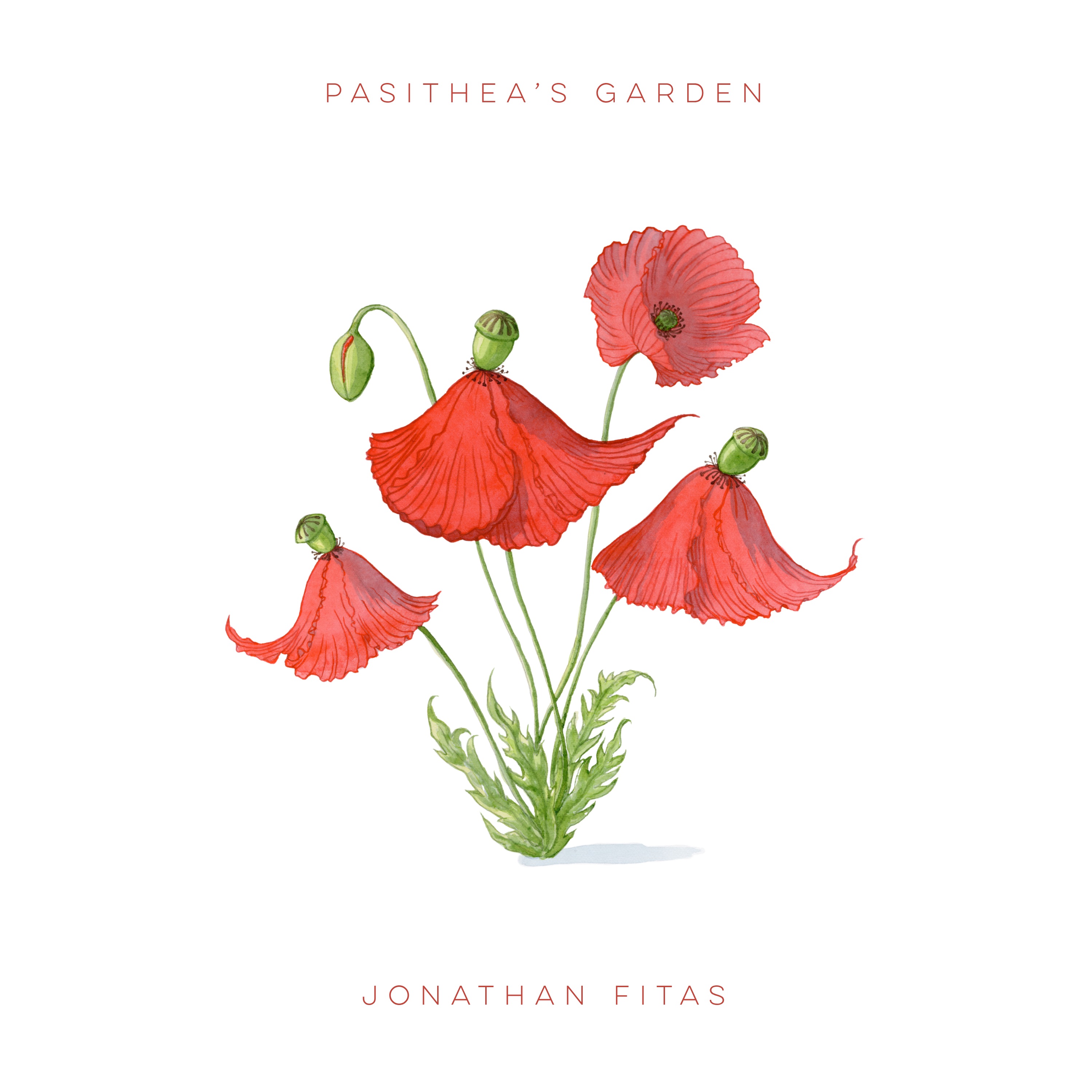
Sophia Vesna painted the cover in watercolour: red poppies on their stems, corollas opening wide and full like the skirts of dancers caught mid-turn. Poppies — the old flower of sleep and dream — dressed for a ball no one is quite awake to see.
And then the garden gate closes. What waits beyond it is the record itself, due 9 October.
Listen to Pasithea’s Garden →
Espresso — a chronicle of consented heteronomy
2026 · 08 · 15 · release · maison mujō
Every weekday at 7:30 a.m., Sophia Vesna switches on her streaming setup. The live will last three hours. On the table: an A5 sheet of watercolour paper, coffee, and a hundred or so people watching. It is here, since 2024, that Espresso is made — some fifty sheets to date, at a rhythm of one every two weeks. That time cannot be seen, yet it can be read everywhere, in the density of the figures as in the care given to the most thankless areas. The work begins at the first live and is finished only at the signature; the sheet keeps the whole memory of the “spect-actors” who helped create it.
The coffee is splashed live, before the audience. Nothing is prepared, nothing can be corrected. The material does not forgive, and neither does the live: two irreversibilities laid one over the other, the second redoubling the first. What chance deposits on the paper, no one — neither the artist nor the viewers — will ever see otherwise.
There is, in the choice of coffee, an obviousness we must refuse to find trivial. The morning slot, the cup: the material and the hour answer each other.
The collective
Then comes what sets this practice apart from all those it resembles: it is the viewers who propose. They look at the stain and say what they see in it — a bird, a teapot, an angry old man. This is pareidolia at work, the brain’s tendency to project the known onto the formless, the one that makes faces in electrical sockets and animals in clouds. Ordinarily solitary and fleeting, here it is public, verbalised, archived in the chat; it becomes an ode to the imagination.
What we observe then has something of stigmergy, that mode of coordination where each contribution modifies the environment and steers the ones that follow. A first reading is proposed; it suddenly makes certain forms visible and hides others; the second builds on the first, the third on both. The field of possibilities closes, suggestion after suggestion, without anyone having decided anything. It is a collective imagination in the proper sense — not the sum of individual imaginations, but a form that would exist in none of them taken alone.
Sophia Vesna arbitrates, and that is where everything is decided. The audience constantly pushes to overflow — a figure is always easier if you allow yourself one more stroke — but the rule, stated aloud during the lives, forbids it: everything that will appear had to be there already in the stain; nothing is added from without. This constraint of immanence founds a consented heteronomy in which the artist gives up almost everything to keep a single prerogative, that of saying no. A minimal and absolute power, enough to make a stream of suggestions a work rather than a poll. It produces losers, discarded readings that will never return, and a muted tension toward completion: the audience wants to see the thing finished while the artist works at the pace of what the stain consents to yield. For no stain is ever abandoned, and the thankless areas, those where no one sees anything, make the ends of sheets the slowest and most tense moment. One waits to find — and on a platform devoted to the abolition of dead time, that waiting is not a flaw of the format but the very condition of discovery, received by the audience as a value and a form of hospitality.
The filiation
The procedure has a name. Justinus Kerner, a German poet and doctor, published his Klecksographien in 1857: folded inkblots, turned into ghosts and creatures, accompanied by poems. He drew a method from it, which Hermann Rorschach would turn into a clinical instrument in 1921. Kerner remains the most exact kinship — the stain stays sovereign there, visible as such, and figuration is only an added reading. The difference is one of tone: Kerner folds, hence symmetry and a funereal register; Sophia splashes, hence asymmetry and comedy. Filiation by method, inversion of tone.
Upstream, Leonardo da Vinci already advised staring at stained walls to see battles in them. Victor Hugo, closer still by the material, stained his papers with coffee and grounds to bring forth castles and spectres. His friend George Sand practised, in the same period, what she called her dendrites: watercolour crushed between two sheets, from which she then drew forests and landscapes by following what chance had deposited. Same gesture, same renunciation of the prior project.
One might think of Pollock and tachism; one would be wrong: dripping seeks no figure. Here the work has two distinct moments, the stain then its reading, and it is that doubling that makes everything. In contemporary creation, there is Stefan Kuhnigk and his Coffeemonsters: coffee, monsters, the stain first. Or Giulia Bernardelli, who paints with coffee with a virtuosity that stages the overturned cup.
Fifty sheets reveal a trajectory. First the monochrome coloured pencil, tuned to the tone of the coffee — the drawing obeys the stain. Then the precision pen, black on sepia — the outline of the illustration asserts itself, lines finer, more contrasted. Then come two pieces on the theme of birds, watercolour and polychrome pencils, then trials on coloured inkblots: attempts at emancipation, departures from the original matrix. Today, a return to coffee, but in polychromy of coloured pencils.
The sheets circulate, and we must beware of taking them for mere relics of the live. They are looked at on their own, outside the story that produced them — it is on that condition, indeed, that they sell. On TikTok, live, sometimes before they are even finished: the collector then acquires an object whose final form is unknown, buys a process under way and trusts what will come out of it. Shown in 2025 at the Brûlerie de Bernay, where exhibiting coffee drawings in a place devoted to coffee is no coincidence.
Her website (sophiavesna.com) gives the most exact proof of it: on mouseover, each sheet sheds its drawing and returns to its first state, the immaculate stain. There, in a single gesture, one sees the work’s two moments — the matrix and its reading — an original, almost visionary way of making visible what the live alone left to be guessed.
The title of the series holds in this ambiguity: Espresso, the coffee and the expression, the material and what one draws from it. None of this claims any theory. The proposal has no ambition beyond a shared artistic moment, held each morning with constancy and kindness. That is precisely what makes it describable: it does not seek to justify itself, it is content to take place.
There would then be reason to file this practice under online entertainment — the vertical format, the chat’s participation, the live selling. That would be to miss the essential. What is at play at every live is a formal rule, publicly stated and held under the pressure of a hundred people who, without ill intent, spend three hours suggesting it might be loosened a little. Art surfaces in every corner of the page, and the finished sheets are the witness to it.
Read also on Maison Mujō: Sophia Vesna — artist profile, the interview “There’s no undo button in traditional art”, and Échos Graphite, her first exhibition. Watch it live on TikTok, Twitch, and sophiavesna.com.
A Discussion with Sophia Vesna
2026 · 07 · interview · maison mujō
A multidisciplinary artist, Sophia Vesna has worked with Maison Mujō for several years, notably around her solo exhibitions — her full story lives on her artists page. Here, we wanted to return to her aspirations, her relationship to making, and the threads running through her work today.
Q: You’ve had many lives — acting, modelling, drawing. If each of these disciplines taught you one essential thing, what would it be?
I started modelling at six, and at that age it mostly took away my self-confidence. The pressure to always be “beautiful”, “thin” and “pleasant” created an unhealthy obsession in me, especially through my teenage years, when I went through severe acne. However much I tried to hide it, castings dried up, and my self-esteem hit rock bottom. Thankfully, acting helped me rebuild that confidence in my body and in myself, and I learned to stop being afraid of expressing myself in front of others. Drawing, which I’ve also practised since childhood, taught me to enjoy solitude — I dive in and never notice the time pass.
Q: How are your days structured now, as an artist?
For each project I keep a rigorous schedule that I try to follow to the letter. Monday to Wednesday I handle everything administrative — social media, outreach. Thursdays and Fridays are days of pure creation: I switch off my phone and don’t touch it all day; the world can wait. I can draw non-stop for eight or nine hours, and it’s only when I stop that I realise everything aches. I need to learn to take breaks, haha.
Q: Which part of the creative process is most exciting for you?
Adding colour and working the details! That’s the moment when everything comes to life — and also one of the most stressful. For instance: you’re working in watercolour, and if your brush loaded with black paint drops onto your beautiful blue-sky gradient, you have to try to erase the unerasable, or draw a big seagull to hide the disaster — it’s terrible, haha.
There’s no undo button in traditional art, unlike the digital.
Q: What is your relationship to digital art?
It’s a tool that saves a great deal of time, but I don’t practise it, and I don’t know if I ever will. On top of that, we’re already seeing artists have their singular touch copied by AI in a matter of seconds — and without an original physical object, what will be left of the artist’s work? I wonder whether those who work digitally won’t eventually return to traditional art, to recover something unique and physical.
Q: Is there a doubt, a fragility or a tension running through your work right now that directly shapes your artistic choices?
Depression, sadness and anger are often my engines. Diagnosed with ADD a few years ago, I felt both the relief of understanding that I’m neither lazy nor stupid — contrary to what I’d been taught to believe — and the torment of figuring out how to live with it, and the unwanted weight it places on the people close to me. I turn all of that into something beautiful and strange, expressing these emotions subtly and often with humour, whether through the imaginary characters of Espresso or the line work of my Textures collection.
Q: How would you describe your approach to creation — technically as well as aesthetically and philosophically?
Often, ideas come to me as images right as I’m falling asleep. I sketch them straight into my notebook so I can bring them back out at the right moment. These last few years have brought me many dark, anxious images, no doubt fed by current events. I can’t wait to put them on paper. I’m self-taught, and every day I learn by testing, by exploring different movements, drawing on artists around me or the masters of the past. I give myself the freedom to be wrong, to change direction if it no longer suits me, or on the contrary to go deeper into what I love until I reach my own “ideal”. I’m also trying, more and more, to own my dual Belarusian-Japanese culture in my work. For a long time I hid it, out of modesty and a wish to fit in, to fit the mould. But I realised that the more I own who I am, the simpler everything becomes. I think that’s precisely what interests people in what I do.
The more I own who I am, the simpler everything becomes.
Q: Which themes matter to you today, that you feel you need to explore in your coming collections?
It’s hard to stay unmoved when the world is burning — both literally and figuratively. What deeply concerns me is the violence human beings inflict on themselves and on nature in their endless pursuit of profit. We’re all part of it, consciously or not. Through my work I try to pose a question: how do we live with this reality once we’re aware of it? And what could we do better, as humans, for our planet.
Q: Are there techniques, materials or formats you haven’t explored yet that especially draw you?
No shortage of desires! I’d love to work gold leaf into my watercolours, paint murals, and collaborate with brands so my illustrations adorn their products — perfumes, clothes, furniture and so on. But concretely, I’m already deep into a new challenge: an autobiographical graphic novel about the childhood of a little Belarusian girl in Japan, confronted with existential questions tied to being constantly reminded of her difference by both societies. It was in telling these anecdotes to my friends in France — convinced they were universal — that I realised my experience was perhaps less ordinary than I thought. And that this story might resonate with someone, one day. If I’m starting now, it’s also because certain situations I’ve lived in France bring me back to that period, and I felt the timing was right.
Q: Could you name a work and a moment in your career you’re especially proud of?
To date, it’s clearly Suikomu — “to inhale / to draw in” in Japanese. While organising my first exhibition, Échos Graphite, made up of some thirty A5 graphite works, I decided at the last minute to add one large A2 drawing. I had only two weeks left to conceive the idea, make sketches and tests, order the frame and produce the piece. It was one of the best decisions of my life: the drawing sold a few days after the opening. In it, I imagined a world being drawn into a gigantic black hole, until nothing remained but the viewer. Through perspective, the work breaks the fourth wall: the onlooker understands they will be the next and final thing to be swallowed. I wanted to evoke a feeling of solitude, anguish and powerlessness. Of course, art is subjective… and some people saw a hot-air balloon. That works too, haha.
Doré joins Maison Mujō
2026 · 07 · maison mujō
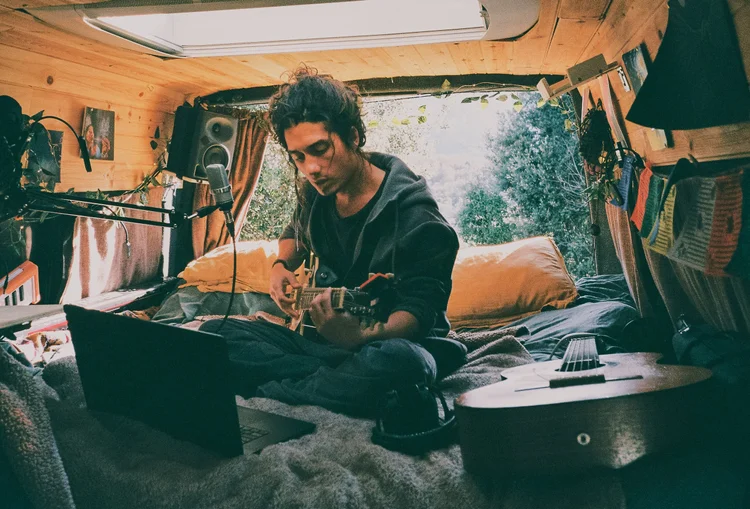
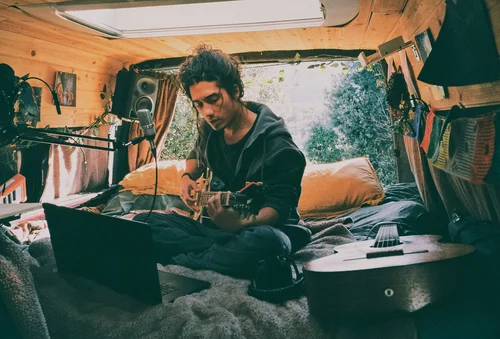
Maison Mujō welcomes Doré, a nomadic singer-songwriter whose studio travels with him — a van somewhere between France and Spain, windows open to the road.
You can’t talk about Doré without talking about travel. He found his voice young, as a kind of medicinal instrument; the guitar came first, companion of campfires and encounters, then the voice — a deeper line to spirit and the invisible. Years on the move, from India to the Amazon, shaped the rest.
Music as a journey through the dimensions of the soul.
His new EP Whisper gathers five tracks that cross folk and cinematic trip-hop — velvet voice, guitar, harmonium and electronic arrangements. Selkie is a tribute to his daughter; Whisper evokes the invisible, a mystical word carried on rustling leaves; I Become speaks of the grace found through experience and connection.
This musical path he signs simply Doré — his first name, a natural signature to his origins.
Drifting (Shuta Yasukochi Rework)
2026 · 06 · 05 · maison mujō · shuta yasukochi
Tokyo-based ambient & sound artist Shuta Yasukochi presents a delicate reinterpretation of Drifting, the melancholic piece by French neoclassical composer Jonathan Fitas — whose original track is approaching one million streams across platforms.
Adding layered modular synths, processed guitars and a vibrant, wide mix, the rework expands the emotional horizon of the original while preserving its quiet, peaceful essence.
Jonathan and Shuta first met during the Noor Riyadh 2022 Festival in Saudi Arabia, where both were composing music for separate immersive artworks. Their shared sensitivity for atmospheric, introspective sound quickly led to a musical connection — Jonathan emerging as a distinctive voice of the French neoclassical scene, and Shuta as a recognised figure of the Japanese ambient landscape.
Azu Kimura — “Thread of Being”, the spider & the sound
2026 · 06 · 15 · interview · maison mujō
Azu kimura is a visual artist living between tokyo and kofu, japan. A graduate of musashino art university’s faculty of art and design, she worked as a designer at a garden and flower company — an experience that drew her ever deeper into plants and living organisms, and finally into a practice built around the theme of life. Across drawing, sculpture, installation and moving image, she traces the intricate ties between living beings and the worlds they inhabit.
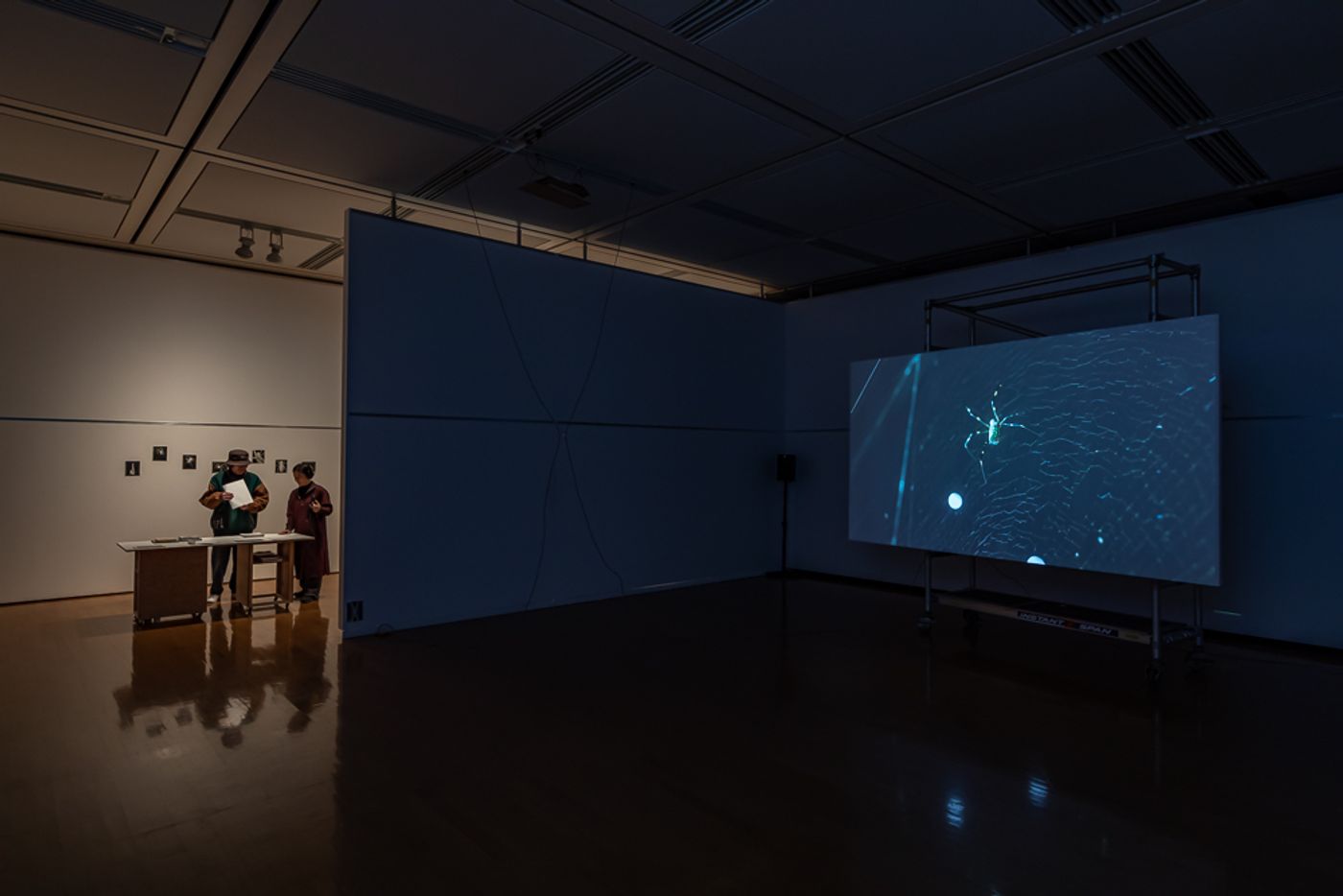
For thread of being — her film centred on the jorō spider, shown at fuchu art museum’s citizens’ gallery in 2024 — kimura asked jonathan fitas to compose the sound. His project infrasonge sits at the contemplative edge of asmr, treating sound less as accompaniment than as a physical, inhabitable space. We spoke with her about umwelt, the perceptual worlds of other creatures, and what happens when a spider’s web is given a body in sound.
We can never truly know how another creature experiences reality.
Q: Azu, can you introduce yourself and tell us about your artistic journey?
After graduating from an art university in tokyo, I worked in landscape horticulture. Through that experience, my interests gradually expanded beyond plants to include insects, geological formations and other elements closely connected to them. Today, my work mainly explores the theme of life.
For example, I have raised insect larvae and made drawings using pigments found in their droppings, and I have made works using iron-oxide films collected in the field, associated with iron-oxidising bacteria. Fieldwork plays an important role in my practice, and I develop my work through encounters with non-human organisms and natural phenomena.
I’ve also spent many years observing jorō spiders. For a long time, I wanted to make a moving-image work that explored their behaviour and the way they experience the world.
Q: Your work explores the relationships between humans and the natural world, particularly through the concept of umwelt. Can you explain this approach?
In japan, there’s a tendency to give names to animals and other living things, and to relate to them in quite anthropomorphic ways. I grew up loving animals and insects, and spent much of my childhood observing, drawing and caring for them.
Later, I encountered the writings of jakob von uexküll and learned that every living being inhabits its own unique umwelt, or perceptual world. I was deeply struck by the realisation that we can never truly know how another creature experiences reality.
At the same time, a spider’s web cannot exist independently of its environment. Its form changes according to the landscape and the space around it. In that sense, it emerges through a relationship with the world rather than existing on its own.
The spider and I breathe the same air and share the same environment. We’re not isolated from one another but connected through networks, much like the threads of a web. That feeling of interconnectedness lies at the heart of this work.
Q: Since 2021 you’ve observed jorō spiders daily. What fascinated you about them to the point of making them the central subject of thread of being?
Jorō spiders are very familiar creatures in japan. They can be found almost everywhere, from cities to rural landscapes, which makes long-term observation possible.
They’re also relatively large, with long legs, and there’s a particular beauty in the way they move — slow and graceful. I felt they would translate especially well into film. For those reasons, I chose the jorō spider as the central figure in the project.
Q: How did you discover jonathan fitas’s work, and what made you want to collaborate with him?
At the time, I was sharing a studio with another artist who had been a fan of jonathan’s music for years. I’d been struggling to find the right sound for the film, so I showed her some footage and asked for her thoughts.
She immediately recommended jonathan’s work, particularly infrasonge #5 ‒ rainfall. As soon as I heard it, I felt a strong connection. It seemed to fit the atmosphere of the film perfectly, so I contacted him directly and asked if he’d be interested in collaborating.
Q: What particularly touched you in his music? What were you expecting from this sonic collaboration?
What I love most about jonathan’s music is the way it evokes images and places. Whenever I listen to it, vivid landscapes seem to appear in my mind.
At the same time, his work feels less like a conventional composition and more like sound as a physical presence. It doesn’t simply accompany an image; it creates a space around it.
Infrasonge #5 ‒ rainfall is centred on water, and there are scenes in the film where the spider is covered in droplets. I felt the texture and atmosphere of the music resonated beautifully with those images.
Q: In the exhibition concept you write: “something that does not exist in the spider’s world becomes present when it is caught in the web.” how did jonathan’s music help translate this idea?
Jorō spiders are thought to rely more on vibration than vision. If I bring my hand close to a web, the spider often doesn’t react, but it responds immediately to subtle vibrations travelling through the silk. In that sense, the web functions as an extension of its sensory system.
In the film, a white sphere touches the web and triggers a response from the spider. This represents the moment when something new enters the spider’s umwelt.
I also see this as a metaphor for human perception. There may be countless relationships, connections and networks around us that we simply don’t notice.
Jonathan’s music has a remarkable ability to evoke things that exist just beyond conscious awareness, as well as the subtle presences hidden within silence. Even the title infrasonge feels deeply connected to the themes of the work.
Q: You also created the installation spider thread telephone, using a 440 hz tuning fork and jorō spider silk. What role does sound play in exploring these creatures’ cognitive abilities?
Jorō spiders are said to recognise vibrations between roughly 300 and 700 hz as signals associated with prey, and they’re thought to respond to the vibration of a 440 hz tuning fork.
In spider thread telephone, visitors listen through a paper cup to the vibration of a tuning fork transmitted along spider silk. The work is an attempt to offer a small glimpse into a sensory world humans can’t directly experience.
A central theme throughout my practice is the act of trying to understand what remains beyond our understanding. This installation is one way of approaching that question.
Q: What do you take away from this collaboration with jonathan? Do you have other projects combining visual art and music?
For the exhibition at fuchu art museum, I installed multiple speakers throughout the space to create an immersive environment. When I finally experienced the film and jonathan’s music together in the gallery, I was genuinely surprised by how tangible the spider’s presence became — it felt as though the spider was actually there with us.
In the future, I’d like to keep researching the vibrations produced by spiders themselves. I’d love to explore making music using spider silk and spider-generated vibrations as part of the composition process.
Recent exhibitions include thread of being (fuchu art museum citizens’ gallery, 2024), life of insects (university of tokyo komaba museum, 2023, within fundamentalz fes) and landscape of iron (nidi gallery, 2022).
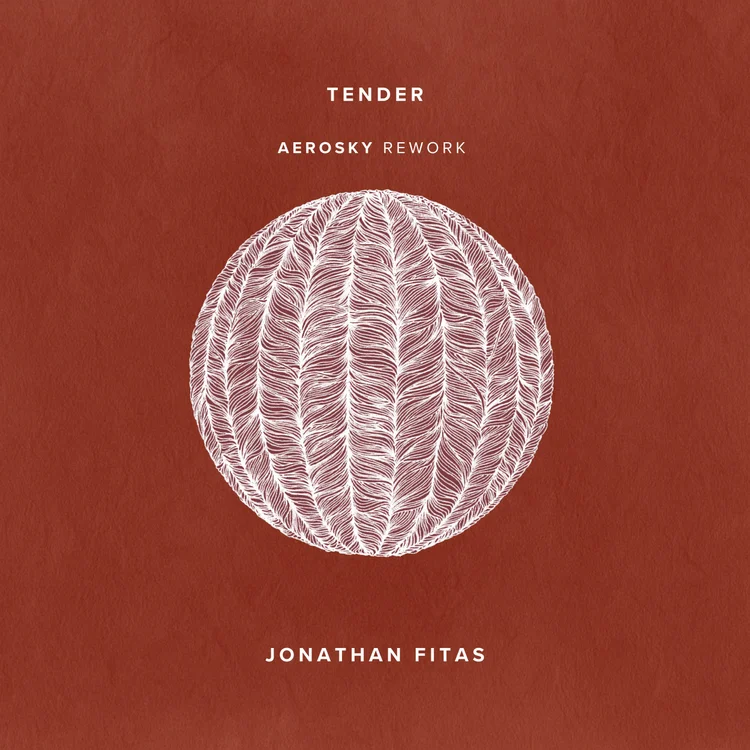
Tender (Aerosky Rework) — featured on Qobuz
2026 · 03 · 18 · maison mujō
The lo-fi rework of tender by jonathan fitas is live.
Aerosky — also known as lechiffrebeats — is a german producer working mostly in lo-fi and ambient. His sound leans into sleepiness and cozy atmospheres, the kind of thing made for late-night study sessions or quiet mornings. For this rework he took tender and reduced it to piano, minimal layers, lo-fi beats and enough space to let it breathe.
Minimal, nocturnal, and made for the hours after midnight.
The release landed just in time for world sleep day, and qobuz picked it up for the editorial playlist tied to the occasion — a small but real moment of visibility, especially for a track built around stillness and introspection.
Cover hand-drawn by sophia vesna. Out now across all platforms via maison mujō.
Origines — discover the OST
2025 · 12 · 16 · maison mujō · arte
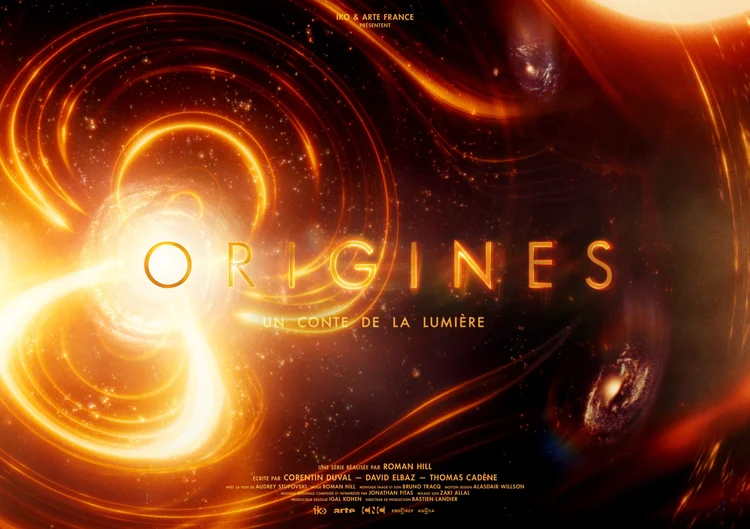
Origines, the documentary series directed by roman hill, is now available on arte.tv. Co-produced by arte and iko and narrated by audrey stupovski, it blends scientific insight with large-scale visual poetry — written in collaboration with astrophysicist david elbaz, alongside authors corentin duval and thomas cadène, with music signed by jonathan fitas.
Since the big bang 13.8 billion years ago, light has shaped the universe into ever more complex structures — stars, galaxies, clusters, nebulae, black holes. Rather than render these through traditional astrophysical imagery, origines uses a visual language hill developed himself: through macro cinematography he captures liquids, pigments, chemical reactions and light in motion, evoking the behaviour of astronomical entities at unimaginable scales.
The result is a hybrid experience — part documentary, part abstract visual meditation, part immersive art piece — inviting viewers to witness the birth and evolution of the universe through the narration of light.
Jonathan fitas’s score plays a structural role in shaping the emotional and narrative rhythm of the series, moving between felt piano, soft strings and expansive electronic textures — a soundscape that mirrors the tension between cosmic violence and delicate emergence.
Beyond instrumentation, what binds director and composer is a shared experimental approach. Just as hill makes his cosmic imagery through hands-on experiments with liquids, pigments and light, fitas builds much of his musical language through sound experiments — field recordings, manipulated textures, layers of processed audio. Both build worlds from materiality, transformation and chance.
Not merely accompanying the images, but actively shaping the viewer’s emotional trajectory.
To accompany the release, the full soundtrack is out now — seventeen carefully arranged pieces, including extended versions designed to let listeners re-experience the series with their eyes closed. In these longer forms, the score becomes not a companion to the images but a standalone immersive journey.
“I Am Light” — first single from the Origines score
2025 · 11 · 21 · maison mujō
Maison mujō unveils I am light, the first musical excerpt jonathan fitas composed for the newly released arte.tv documentary origines.
Origines is a cosmic documentary that revisits the formation of the universe through macro imagery, dynamic pigments and light-driven experiments captured by director roman hill. Rather than illustrate space with telescopic footage, the series translates astronomical cycles into abstract, flowing matter — a sensory perspective on the origins of the cosmos. Developed with astrophysicist david elbaz, it blends scientific concepts with an artistic approach to visual storytelling.
A luminous first glimpse, before the universe expands.
I am light introduces the musical identity of the series, unfolding in a delicate balance of piano textures, subtle strings and minimalist atmospheric layers that mirror the emergence of luminosity as a theme. Calm and contemplative, it is an intimate doorway into the sound world that accompanies the documentary’s visual language.
This single marked the beginning of the soundtrack’s unveiling. The full seventeen-piece original soundtrack, including extended compositions made for immersive listening, was released on december 15, in parallel with the series’ arrival on arte.tv.
Flow — The Glow You Left Behind Rework
2025 · 09 · 19 · maison mujō
Flow reworks the glow you left behind, jonathan fitas’s neoclassical original, by threading subtle drum & bass energy through it.
The same song, walking faster.
The piano and strings remain, but the floor underneath them shifts — broken rhythms and expanded electronic textures pull the piece somewhere more restless, neoclassical roots meeting an electronic pulse.
Released september 19, 2025 via maison mujō.
Jonathan Fitas — “Leap of Faith”
2025 · 03 · 21 · maison mujō · whales records
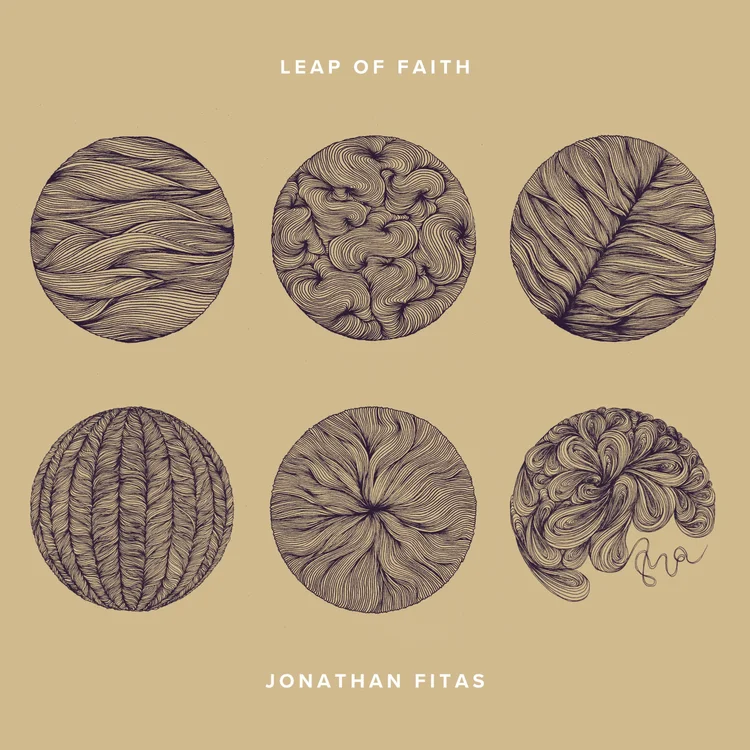
Leap of faith is jonathan fitas’s ep — the record of leaving paris for the countryside, and of what music sounds like when nothing rushes it. For years he composed at night, letting emotions gather without naming them, until the only option left was to jump.
Music you can breathe in, where tension doesn’t explode but slowly transforms you.
Piano, strings and synthesizers — simple materials carrying that movement between stillness and vastness. Some pieces unfold in layers, others hold to a single fragile thread. flow carries the nostalgia of youth; radiance is brighter, almost a prayer to what we can’t control; searching for tora, written after losing the family cat, is a small ritual of mourning.
The ep was shaped by a new place — their home in normandy, which became studio, refuge and residency, and where maison mujō itself emerged, in the quiet and the woods, far from paris. Cover art hand-made by sophia vesna; released march 21, 2025 with whales records.
Radiance — a dance film
2025 · 03 · 20 · théo gottlieb × jonathan fitas
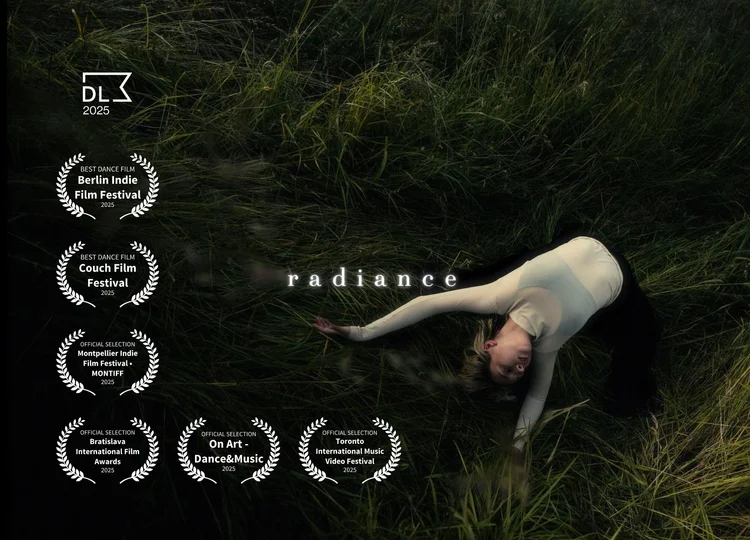
Radiance is an award-winning contemporary dance film by théo gottlieb, built around jonathan fitas’s neo-classical piece.
The score, given a body — a single dancer translating sound into motion.
Through intimate choreography and minimalist cinematography, the film lets the music move. It went on to receive the ingenuous prize, a recognition of how completely image and score answer one another.
Watch the film
Infrasonge — from ASMR to contemplative soundscapes
2025 · 01 · interview · diego garro
Originally published on asmryouready.com in march 2016 by diego garro, this interview sat lost in the depths of the internet for years. It is reposted here for archival and cultural purposes.
Almost forgotten gems occasionally surface within the vast landscape of asmr creators. Among them is film composer and sonic artist jonathan fitas, whose project infrasonge sits deliberately at the fringes of the genre. The youtube channel never chased virality — most videos gathered only a few hundred views — but those who listened found something intimate and meticulously crafted.
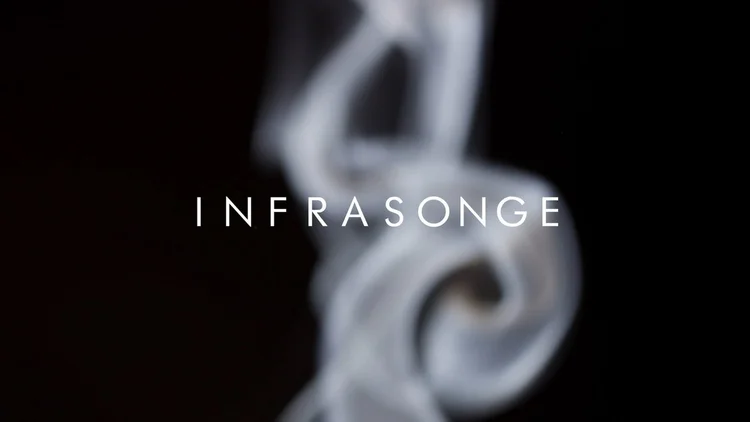
Though built on asmr’s codes of immersion and attentive listening, infrasonge pushes the format into something deeper: sound as atmosphere, as architecture, as contemplative space. Each video pairs a slow, smoke-like visual with layers of recorded sound — never pure synthesis — shaped into spacious compositions.
Listeners describe it not as sounds coming toward them, but as being inside the sounds themselves.
Paintings made with sound: fuzzy bass textures, delicate crackles, distant waves and microscopic details recorded extremely close to the microphone. What follows is the full conversation, as it first appeared.
Q: How did you first encounter asmr — both as a personal experience and as online content?
My first asmr experience goes back to childhood — moments I don’t fully remember, like my father teaching me math; his dedication and passion did the trick. Online, I’ve never felt strong tingles, but I found the videos soothing and captivating. What I love is the immersion — not only through binaural technique but through duration. Asmr videos take their time, and that is amazing to me. It led me to research asmr during my master’s, and finally to experiment with it through infrasonge.
Q: How do you relate to the asmr creator community?
The community is wide and open to experimentation — that is why I started. It is a welcoming space, willing to listen and discover new things. The keyword for this project is experimentation, without creative restraint, bringing in what I learned from sound design and audio mixing as a film composer.
Q: Did you consciously adopt asmr-type materials?
Not really. I focus on sounds that please my ear; I don’t ask whether something is an “asmr kind of sound.” asmr is about listening and transmission more than specific materials. Some sounds became iconic thanks to certain creators, but as experience shows, any sound — quiet or loud, high or low — can trigger it.
Q: What role does the microphone play in your creative process?
A leading one. I record something every day. Almost everything I use is captured with microphones; I use very few electronic sources, and even sounds that seem synthetic usually began as recordings. I love that recordings carry an unpredictability and liveliness hard to replicate with modern synths — and I’m a sound geek, I just love manipulating them.
Q: Your compositions are spatially rich. How do you build ambience, location and movement?
It depends on the material. I record mostly close-proximity, because I don’t like my studio’s room acoustics; I strip the ambience and add artificial reverb later to play with distance. For movement I use binaural and surround processors, which open endless narrative possibilities for spatial design.
Q: What artistic or technical influences can be heard in infrasonge?
I try not to work with references in mind — my other projects already demand that — but I keep returning to jon hopkins, and luc ferrari’s presque rien n°2 isn’t far either. As a listener I’m hugely impressed by dmitri of massageasmr; he built an entire studio for asmr videos, and his craftsmanship is what encouraged me to experiment within the genre.
Q: What is your creative approach? Do you follow a plan?
Usually it begins with the urge to record and play. I don’t start a piece until a few sounds catch my ear — it is like getting new toys, I just play with them for hours. Then I build in layers and distances: some sounds almost touching the ear, others far away, giving the sound a stage to travel across.
The clues are in the titles. For #5 rainfall I had worked two ideas for weeks — a rain texture and a piano — without knowing where they would go, then combined them and wrote the space between the two. It is all trying, re-trying, doing, undoing and doing again until the structure feels right.
Sophia Vesna — “Échos Graphite”, first exhibition
2024 · 06 · paris
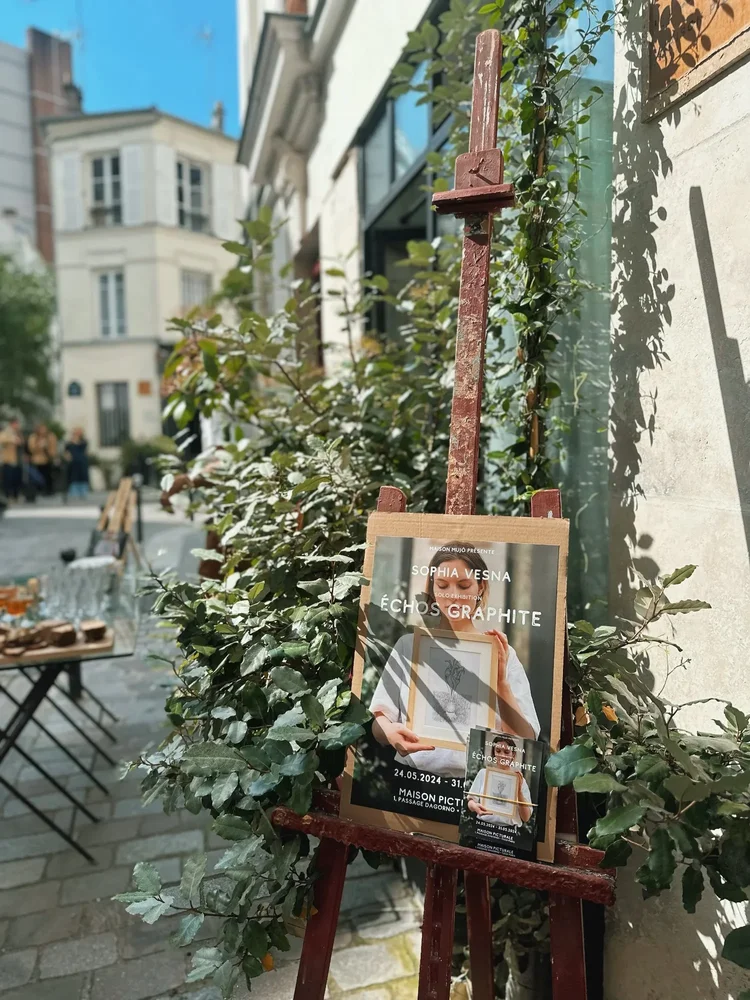
By the evening of may 24, 2024, the normally quiet passage dagorno in paris was humming. An easel outside maison picturale held a whimsical poster for échos graphite, and nearly two hundred guests had gathered, spilling from the gallery onto the sidewalk — friends, neighbours and art lovers under the spring sky, glasses in hand, soft music playing. A passing neighbour even bought one of the works, making the evening more of a success still.
Graphite works that reward standing close.
From may 24 to 31, 2024, maison picturale in paris’s 20th arrondissement hosted échos graphite, the first solo exhibition by belarusian artist sophia vesna. The show gathered a series of graphite pencil drawings made in dialogue with gabriel chirouze’s poetry book fabuleuses démangeaisons.
The works explored childhood, melancholy and a surreal tenderness, executed entirely in graphite — a medium vesna describes as natural and familiar from an early age. Several pieces nod to early animation, classic disney films in particular.
The exhibition marked the beginning of vesna’s journey as a visual artist and laid the foundations for her projects in france and beyond. She also makes the hand-drawn covers for several maison mujō releases.
Jonathan Fitas
Composer & founder — 2021
Born in 1991, Jonathan Fitas began his musical path as a violinist before turning to composition. Early on, he became known for his work in advertising — for brands such as Hugo Boss, La SPA, Asics, Sidaction, Rochas, Caisse d’Épargne, Sisley and Withings — often working with director Théo Gottlieb, whose emotionally driven approach matched his own. He soon moved into film scoring, with his first notable work being No Limits (2015), a documentary about Paralympic champion Alessandro Zanardi. He later composed for the short film Ailleurs (2020), featuring Raphaël Quenard, and for Kin, Tout est Vie (2021), an intimate portrait of the artist Damso.
In 2021, he released his debut EP Beyond the Loop on Naïve Records, becoming one of the label’s first French neoclassical signings. Apple Music described it as “a beautifully conceived collection of magical, mesmerizing soundscapes,” while Les Oreilles Curieuses wrote that his work “carries the influence of Nils Frahm and Ólafur Arnalds.”
A talent to watch in the French neoclassical scene.
His immersive art work expanded his international presence. Shortly after the opening of Atelier des Lumières in Paris, his music featured in landmark shows such as Life & Chaos (2019) and Verse (2019). His work continued with Verse at Infinity des Lumières in Dubai (2020), then Horizon and New Land at OASIS Immersion in Montreal (2022). That same year, he was selected as one of the leading artists of Noor Riyadh for IMPULSE, an audiovisual collaboration with Roman Hill.
In 2025, he released Leap of Faith, published by Maison Mujō in partnership with Whales Records and strongly supported by Apple Music. That same year, he composed the original soundtrack for the ARTE series Origines and produced Maison Mujō’s first music video, Radiance — directed by Théo Gottlieb and recipient of several major awards.
By now, his catalogue has surpassed 2.5 million streams across Asia and the US, with strong audiences in Tokyo, Seoul, Beijing, Los Angeles and New York — driven by works such as Drifting, Ingenuous, Inside and Tender.
Based in Normandy, he founded Maison Mujō as a space rooted in his core values — animal protection, preservation of nature, and creating art in a peaceful environment — with the long-term aim of opening an artist residency in 2027.
Sophia Vesna
Visual artist & actress — 2024
Sophia Vesna is a Belarusian self-taught artist whose visual language blends narrative drawing, surreal intuition and poetic restraint. Born in Minsk in 1995, she spent her childhood between Eastern Europe and Japan, having moved to Tokyo at the age of six with her mother. This dual upbringing — steeped in Slavic folklore, ukiyo-e woodblock prints and animation — continues to shape her dreamlike aesthetic, where intimate worlds emerge in graphite, ink and improvisation.
Originally trained in the performing arts, Vesna studied musical theatre in London and drama at Cours Florent in Paris. She worked as an actress in short films and series — including roles in The New Look (Apple TV) and Kreskine (2023) — before shifting her focus to drawing as a more inward, personal form of expression.
I realized I wanted to create characters as much as I enjoy embodying them.
Her first exhibition, Échos Graphite (Maison Picturale, Paris, 2024), featured a series of graphite illustrations for Fabuleuses Démangeaisons, a poetry book by Gabriel Chirouze. Her work — quiet, melancholic and precise — explores childhood, nature, femininity and memory, with a surreal, almost whispered intensity.
In 2025, Vesna debuted her Espresso series, splashing brewed coffee onto paper and drawing over the random stains with fine-liner ink, revealing hidden figures and imagined stories. Performed live on TikTok and Twitch in four languages — Russian, Japanese, French and English — the process has become a signature of her practice, tactile and deeply interactive.
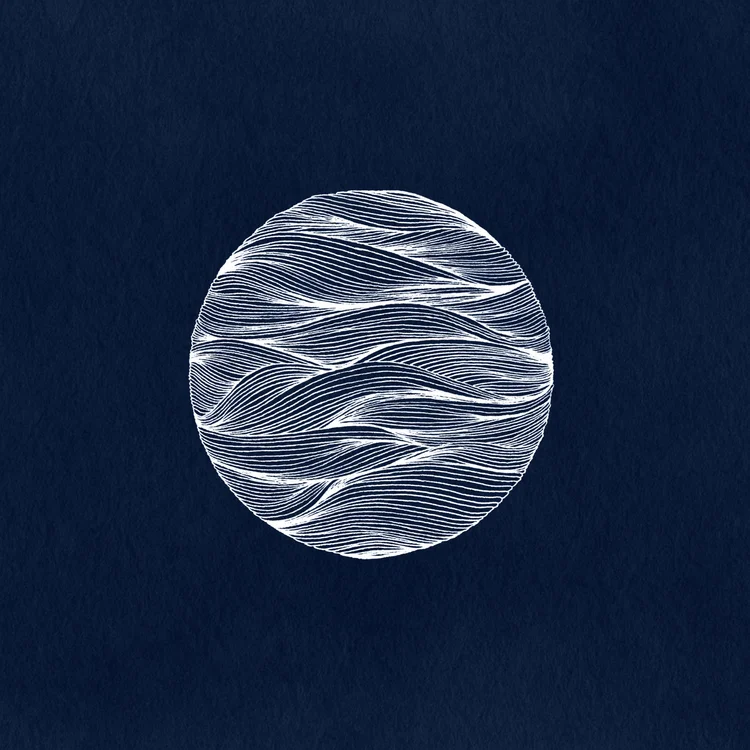
She also collaborates across disciplines. Her Textures series, created in dialogue with composer Jonathan Fitas for his EP Leap of Faith (2025), transforms sound into visual form — six abstract ink drawings printed on textured paper with a blend of pigment and Normandy soil.
Now based in Normandy, she continues to explore live drawing, artist books and hybrid formats. Whether working in pencil, ink or coffee, Sophia Vesna builds fragile universes where accidents become symbols, and childhood echoes are never far from the surface.
Infrasonge
Ambient · asmr — 2025
Infrasonge is a sonic world that travels from ASMR to contemplative soundscapes, treating sound less as accompaniment than as a physical, inhabitable space.
Where sound becomes space, and listening becomes a journey.
An interview by Diego Garro, written in 2016 and long lost in the depths of the internet, recently resurfaced — a rare glimpse into the practice behind the project.
Most recently, Infrasonge composed the sound for Azu Kimura’s film Thread of Being, shown at the Fuchu Art Museum in 2024.
Doré
Singer & songwriter — 2026
You can’t talk about Doré or his music without talking about travel. He has travelled the world since he was young, where he discovered his voice as a medicinal instrument — a revelation. First came the guitar, companion of campfires and encounters, and then the voice — a deeper connection to spirit and the invisible.
Today, he travels across Europe — somewhere between France and Spain — aboard his van with his nomadic music studio, continuing to explore this unique path where music becomes an ineffable connection.
Music is a journey through the dimensions of the soul.
He presents his new EP Whisper: five tracks blending his velvet voice, guitar, harmonium and electronic arrangements, crossing genres between folk and cinematic trip-hop, nourished by his journeys and encounters. Selkie is a tribute to his daughter. Whisper evokes the invisible, like a mystical word through the rustling of leaves. I Become represents the grace found through his experience and his connections.
This musical journey, he signs it Doré — his first name, a natural signature to his origins.